
Supplementive clauses in final position
(more on page 569, A Comprehensive Grammar of English Language .... by Quirk et al)
15.62 Supplementive clauses in final position
In spite of their resemblance to nonrestrictive relative clauses, supplementive clauses need not be separated from their matrix clause intonationally when they occur in final position. The following are therefore alternative renderings of the same sentence, differing only in that [1] has two focuses of information, whereas [2] has only one:

In spite of their resemblance to nonrestrictive relative clauses, supplementive clauses need not be separated from their matrix clause intonationally when they occur in final position. The following are therefore alternative renderings of the same sentence, differing only in that [1] has two focuses of information, whereas [2] has only one:

One result of the alternative shown in [2] is the possible neutralization of the formal difference between nonfinite clauses functioning as supplementive clauses and those functioning as complementation of the verb. Thus [3] is ambiguous :
I saw Pam going home. [3]
On one interpretation (that of the supplementive clause), I is the implied subject of going home, whereas on the other (that of verb complementation), Pam is the overt subject.
(more on page 569, Comprehensive_Grammar_of_....)

Break
很巧,本來我想寫篇關於錯字的blog,結果剛剛在我的臉書看到這個:
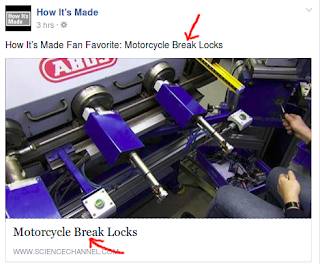 我本來以為真的有"motorcycle break locks"這東西。Google了一下, 顯示出來的也是brake locks。上圖無法看清到底是什麼,所以我點了他們的網頁:

果然是Brake的typo。
我說「很巧」是因為前幾個禮拜我寫了封信(e-mail)給朋友。信裡頭我提到自己DIY換車子的brake pads,結果我通篇寫"break"。信寄出去後一開始也沒發覺。等到發現後想說反正是老友了,也懶得多此一舉的去「更正」。
又不是考試或是交作業,是吧。不過發布 How It's Made 這則消息的人倒是糗大了。


果然是Brake的typo。
我說「很巧」是因為前幾個禮拜我寫了封信(e-mail)給朋友。信裡頭我提到自己DIY換車子的brake pads,結果我通篇寫"break"。信寄出去後一開始也沒發覺。等到發現後想說反正是老友了,也懶得多此一舉的去「更正」。
又不是考試或是交作業,是吧。不過發布 How It's Made 這則消息的人倒是糗大了。
Say "real"

There I was, resting on a bench at a quiet shaded corner in Disney's Epcot theme park. Occasionally one or two park patrons walked by; some stopped and talked to a staff stationed at the entrance of an attraction near me, and left. The attraction was closed apparently. My girlfriend was at another attraction next to this one waiting in line for her space station ride. Two hours of wait time, she'd told me, all excited. I told her I needed a break. Enough with the long wait.
"Say real." When I first heard it, I paid it no mind.
"Say real." Still, I was lost in my train of thoughts.
"Say real. You want Oreo? Say real."
Now it got my attention. I looked up ahead and saw a middle-aged father tending to his toddler. A common scene in Disney that doesn't deserve a full article of its own, but what caught my eyes was the age of the toddler and the racial disparity between these two. The boy, who was in a stroller, could be 6 or 7; kids this age usually refuse to sit in one. Judging by his looks and skin tone, I'd say he was Asian; the dad was Caucasian. Not a rare racial combination because of all the adoptions from Asian countries, but they were the first pair I saw around here.
The kid didn't seem to be able to say the R sound, so the dad kept pressing him with more "Say real," which sounds pretty much like "reo" in "Oreo". The kid leaned forward with his hands reaching towards his dad, but the dad refused to give the boy cookies.
"Say real," dad pushing the kid's hands aside.
"Say real," dad moving the cookie package away from him.
Then another boy came, older, Caucasian. He bent down to the younger boy and blocked my view of the kid. By the look of it, it seemed like he was hugging the kid. At this moment, I was pondering what I'd observed so far. Kids usually pick up a new language very quickly, so my first thought was the dad adopted this kid recently from a foreign country, so he didn't have enough time to learn the new language. But the age of the boy....
In the end, I still didn't know if the kid got his cookies.
 |
| Disney, Epcot theme park |
uh
NOTE: 畢竟我住在美國,所以這篇是以美式發音為主。英式發音有些差異,這我留在最後提。
音標 /ʌ/ 和 /ə/ 到底是要如何發音?這個其實不該只看字面說明。我們先聽聽英文母語人士如何的念這兩個音:

然後和文馨當代英漢辭典的音標說明互相比較一下:
 最後再看KK音標的始祖書: "A PRONOUNCING DICTIONARY OF AMERICAN ENGLISH" by JOHN SAMUEL KENYON, Ph.D. and THOMAS ALBERT KNOTT, Ph.D.
摘自同一本書:

英式"標準"發音的 /ə/ (亦是 IPA 音標/ə/的發音/念法)基本上和我們(傳統)教的 KK 音標一樣。
IPA /ə/(真人發音): https://en.wikipedia.org/wiki/Mid_central_vowel 開頭右邊表格裡頭
音標 /ʌ/ 和 /ə/ 到底是要如何發音?這個其實不該只看字面說明。我們先聽聽英文母語人士如何的念這兩個音:
http://soundsofspeech.uiowa.edu
The website version(需要安裝Adobe Flash Player) 或是App(要付費...)
English Module → 選Vowels → monophthongs → central → (如下方圖示)

注意聽 /ʌ/ 和 /ə/ 這兩個音( /ɝ/ 和 /ɚ/ 也順便聽一下),先消化一下(不要懷疑,網站發音檔沒放錯,你也沒聽錯。不要只聽音標發音,右邊的「整個單字」念法也聽)。
他們網站拿掉 English module,English 版本只有 Apple/Android App 且需要付費。我直接講結論,他們錄製的這兩個音聽起來(幾乎)一樣。整個單字的念法當然有輕重音的分別。
-------------------------
https://youtu.be/RsumYs0z6RY "... both are essentially the same sound made the same way with the mouth...." " /ʌ/ ... stressed, long duration" "/ə/ ... unstressed, short duration" 兩個基本上是同樣的音/相同的發音方式(指的是嘴、口形/舌頭位置)。兩者差別只是在於輕重音/長度。
然後和文馨當代英漢辭典的音標說明互相比較一下:

 |
| 字典它處有對黃體字做說明,表示輕/重音節(的輕/重音) |

一些細部解釋,部份例外變化等等有的沒的這本始祖字典有額外說明,我懶得引了。我直接講結論,簡單說,這兩個音發音其實一樣,差別只是重讀(重音節/單音節/音調較高)和輕讀(次音節/低音節/弱音/音調較低。"schwa"有時也用 /ə/ 表示)而已。其實也不用覺的奇怪,因為在一些語系裡頭即使相同發音,但是不同輕重音/不同音調仍是會代表不同的字(類似我們國語用語調(四聲)來區分不同的字),所以 IPA 用不同的符號將這些不同輕重音/音調的音個別紀錄。
我手頭的 The New Oxford American Dictionary 的音標表只有 /ə/,沒有 /ʌ/,因為這本字典是將這兩個音合併在一起用同一個符號表示。同樣作法的字典還有 World Book Online, Merriam-Webster's Collegiate Dictionary 等等字典:
http://en.wikipedia.org/wiki/Pronunciation_respelling_for_English#Traditional_respelling_systems
相較之下,這本美國字典 The American Heritage Concise Dictionary 用的符號則是 /ŭ/(cut) 和 /ə/(about)。對於 /ə/,字典有這說明:"The symbol (ə) is called a schwa. It represents a vowel that receives the weakest level of stress within a word. The schwa sound varies, sometimes according to the vowel it is representing and often according to the sounds surrounding it.
有空我再補充些細部變化說明
-------
What's the difference between Schwa (/ə/) and Wedge (/ʌ/)?
-------
注意聽他的"love"
-----
The Huntsman: Winter's War 預告
https://youtu.be/eAvCgVR0gIM?t=10s
約十秒處開始: "Mirror mirror ..."
mirror有兩種發音。美式發音: /'mIrɚ/(ɚ 有r;有捲舌)。英式發音: /'mIrə/(ə 無捲舌)。影片中的女星是用英式發音。
KK是用這符號 ɚ ,IPA以及一些字典的音標系統是用 ər。比如:
UK版/發音: http://www.oxforddictionaries.com/definition/english/mirror
US版/發音: http://www.oxforddictionaries.com/definition/american_english/mirror
英式"標準"發音的 /ə/ (亦是 IPA 音標/ə/的發音/念法)基本上和我們(傳統)教的 KK 音標一樣。
IPA /ə/(真人發音): https://en.wikipedia.org/wiki/Mid_central_vowel 開頭右邊表格裡頭
英語母語人士使用字典的情形
英語母語人士使用字典的情形:
http://www.mobileread.com/forums/showthread.php?t=201136
http://www.mobileread.com/forums/showthread.php?t=135658
https://www.usingenglish.com/forum/threads/273718-Help-from-dictionary
http://www.mobileread.com/forums/showthread.php?t=201136
http://www.mobileread.com/forums/showthread.php?t=135658
https://www.usingenglish.com/forum/threads/273718-Help-from-dictionary
Subscribe to:
Posts (Atom)