Showing posts with label 文法篇. Show all posts

Was given to jeans?

THE WALL STREET JOURNAL上的一篇文章: One Doctor's Lonely Quest To Heal Brain Injury
http://biz.yahoo.com/wallstreet/070926/sb119076442562439330_id.html?.v3
https://www.wsj.com/articles/SB119076442562439330

裏頭我有興趣的是這句:

During his time at Clark, Dr. Stein was given to jeans, long hair and shooting his mouth off in faculty meetings or challenging guest speakers, even eminent ones. "Eyebrows would go up whenever Don's hand would go up," recalls...
畫底線之後的部分我讀了好多遍,雖然後頭的意思比較好抓,但是到底什麼是"...was given to jeans, long hair"?本來按照之前的內容他在學校不大如意,那麼我就猜也許這是在說學校把他派給穿牛仔褲留長髮的學生,但是意思不是很合理。又讀了幾遍之後,覺得應該是在說他的"習性"--他當時是穿牛仔褲和留長髮的,只是我不記得"give"有這用法,所以上了Longman ONLINE查give,卻找不到這字義和這用法。後來繼續查其他的字義→given (adj),天殺的,居然在這裡!
Longman ONLINE
given (adjective)
......
3 be given to (doing) something formal to tend to do something, especially something that you should not do:
- He was a quiet man, not usually given to complaining.

雖然都是基本單字,但是整個片語卻是正式用法。

is wearing不是「正在穿/戴」

… is wearing … 不是「正在穿(上)/戴(上)/...」

直接看影片比較清楚:

如果上頭的 yarn.co (或是 getyarn.io) 無法看影片,那麼看這個英文教學影片也行:

  • "What are you wearing? "
    https://www.youtube.com/watch?v=O67zKqPKiYc
    從 [0:20] 開始(或是 [3:08] 處是附上字幕的相同影片)。訪問的人問 "What are you wearing?",接受訪問的少年郎並不是正在把衣物穿上,他回答的是他穿在身上的是什麼衣物:"I'm wearing, uh, black shoes, blue jeans, black jacket, and red top."
    影片接下去則是更多的 "What are you wearing?" 的對話例子。

字典怎麼說?

文馨當代英漢辭典(第五版)

  • (vt.) wear:  穿著(衣、鞋);戴著(帽);戴著(戒子、眼鏡);佩著(槍、劍)
    (★指穿上,戴上時,用put on)
    ....
    • He was wearing a saber. 他配著一把軍刀。 

Longman Dictionary of Contemporary English

  • wear1 ... verb
    1 ON YOUR BODY: ... to have something such as clothes, shoes, or jewellery on your body:
    • Susanna was wearing a black silk dress.

...

Register
In everyday English, people often say that someone has something on rather than is wearing something:
· She had on a black silk dress.

注意讀 Register 部份的說明。


之前的舊資料

https://www.englishforums.com/English/WearProgressiveOrSimple/brwwcn/post.htm
CalifJim:
He is wearing a new coat. (now, as we speak)
He wears his new coat wherever he goes. (always, as a habit)
He was wearing a new coat at the party last night. (then, during the time we are speaking about)
He [wore / used to wear / would wear] his new coat wherever he went. (always, as a habit)
He wore his new coat to the party last night. (then, when he traveled to the party, on that occasion)


https://www.englishforums.com/English/WoreOrWasWearing/brjbhz/post.htm
(1) He wore glasses (2) She was wearing a new coat. ...
.... 'wore' and 'was wearing' ...

CalifJim:
In many, many cases, the two are equivalent. Choose the one you like better.

If you are talking about something that always or usually happens, something that occurs regularly, then wore is probably better.

He (always) wore glasses.
She (always) wore the same coat every day.

https://www.englishforums.com/English/PastContinuousTense/bhvbck/post.htm

Am I wearing my baby correctly?

這可不是「…正在穿我的嬰兒…?」

直接看圖最快:
https://www.reddit.com/r/babywearing/comments/1jmmjpx/am_i_wearing_my_baby_correctly/


In three years/five times etc running


https://www.ptt.cc/bbs/Eng-Class/M.1705579308.A.A93.html

出自新制多益閱讀題庫解析
Tourism numbers in Taipei have been increasing for three years running as people
are beginning to discover this often underrated city.

請問,這邊的running 是什麼意思

https://www.ldoceonline.com/dictionary/three-years-five-times-etc-running

for three years etc without a change or interruption SYN in a row
- She won the prize for the fourth year running.

Could, may, might 的可能性程度


https://www.usingenglish.com/forum/threads/it-may-have-been-pam-who-forgot-to-lock-the-door.300419/post-1912321

"No. They all express roughly the same level of uncertainty (less than 100%). Learners often try to attach levels of possibility to these words. Don’t waste your time on it."


https://www.usingenglish.com/forum/threads/is-could-more-sure-than-may-or-might.300288/

#3
"The difference in modality between these words is not best explained with a spectrum of certainty, in my opinion. I prefer to explain this difference as qualitative—about different kinds of possibility—rather than as quantitative by degree. In some sense, the kind of possibility we get from could is more 'remote' from might, but not really less 'sure'."


https://dictionary.cambridge.org/grammar/british-grammar/could-may-and-might

"We use could, may and might to express degrees of possibility. Many native speakers disagree on which one expresses more or less certainty."

double marking, double perfect, perfect infinitive

... would have liked to have seen ...

The Oxford Dictionary of English Grammar - Page 128
Bas Aarts, ‎Sylvia Chalker, ‎Edmund Weiner · 2014

Double Marking

------

https://www.usingenglish.com/forum/threads/double-perfect-infinitive.137209/

-----

https://forum.wordreference.com/threads/i-would-have-liked-to-have-seen-her.2837818/


pushdown wh-element, parenthetical clause

pushdown wh-element

You can do whatever you think is right.

The Comprehensive Grammar of the English Language (查 pushdown wh-element)
The Cambridge Grammar of the English Language
Longman Grammar of Spoken and Written English


The Comprehensive Grammar of the English Language 第1050頁 (pdf, 531)

[d] If the subject of the that-clause is a pushdown wh-element  (cf.11.18) and is therefore moved to  the  front of  the superordinate clause, the subordinator that must be omitted, perhaps  to prevent that being initially misinterpreted  as subject  of the following verb:

 Who did she hope would be the winner?  [1]
*Who did she hope that would be the winner?  [1a]
 They  pointed out the damage which they supposed had been done by last night's storm.  [2]
*They pointed out  the damage which they supposed that had been done by  last night's storm.  [2a]
Contrast [1b]  with [1]  and [1a]:
Who did she hope (that) that would be?  [1b]
In [1b], the second that is  indeed  the subject of the that-clause; who  is the subject complement and  therefore the subordinator that may be optionally retained, the presence of a subject that before the verb preventing misinterpretation.
    Here are several other examples of optional that when the wh-element  is not the subject and hence a subject appears before the verb in the that-clause:
Who do you expect (that) they have chosen?
She told me how she thought (that) the machine worked.
They mentioned the name of the men (who) they knew (that) you had spoken to.


parenthetical clause

who they say


Studies in Grammar - Page 115
books.google.com/books?id=jdZEAAAAIAAJ
Mabel Clare Hermans - 1924 - ‎Snippet view - ‎More editions
.... In this sentence, "He is the man who they say will be elected", we see that the main thought is "He is the man who will be elected." In addition there is the clause, "they say," which has been inserted and is not dependent upon the independent clause. In other words, it is neither an independent clause nor a dependent clause. It has been thrown into the sentence and is called a parenthetical clause. The relation of the parenthetical clause to the rest of the sentence is shown in this way:

You will see that the complex sentence is complete without these words, but since they are expressed, we ...


Who Versus Whom--Advanced (link 被移除了)
http://www.quickanddirtytips.com/education/grammar/who-versus-whom-advanced

participle phrase

<<別處的回文我另外存一篇備份 / 算是草稿,有時間我再擴充>>

也有學者是用 participle phrase 來稱呼(比如)這句逗號前頭的用法: Carrying a heavy pile of books, he caught his foot on a step.

英文文法(至今)沒有單一的統一標準。光是個"gerund"就有三種解釋/看法 (The Oxford Dictionary of English Grammar)
"限定"關代也有restrictive/essential/defining 三種「指同樣東西」的術語標籤。

"participle/participial phrase"是個較廣義的說法。phrase的基本定義: 不是句子/子句(沒有主詞,主要動詞)的「多個字的組合」。

分詞構句(participle/Participial clause/construction/phrase(這個也有) (*1) )一般(較簡單/基礎)的文法書不會提到這個,因為難度較高/較複雜。關係子句(及相關變化)是基礎文法之一,所以會扯到另外的術語的話一般是用較簡單/一般的"Participial phrase",也因此很多人「以為」這只能是指關係子句簡化的reduced relative clause.

"分詞構句"這術語也是一樣的情況。很多時候只是"方便"的一個歸類說法。然後我前頭說的,英文文法沒有統一標準,所以分詞構句除了有學者用副詞來解釋,也有學者是用形容詞來闡釋(這時候通常是和關係子句相關的reduced relative clause當成一樣的東西一起說明):
https://owl.english.purdue.edu/owl/resource/627/02/
從 "Having been a gymnast, Lynn knew ...." 開始讀
The participial phrase functions as an adjective modifying Lynn.

Dr. Darling 也是: 
https://www.guidetogrammar.org/grammar/phrases.htm#participial

書本的文法書也有,有興趣的人可以用 Google Books 找英文母語學者寫的文法書


https://en.wikipedia.org/wiki/Participle

(*1) 還有其它使用不同字的術語標籤


暫時放在這頁
"I must have been mad to come to this sumptuous place dressed up like a knockabout comedian." -- The Best of James Herriot, by James Herriot

keywords: past participle, not related to relative clause

fronting of objects + as inversion

fronting of objects
https://books.google.com/books?id=aSf2rQQKJAQC&lpg=PA127&dq=%22such%20fronting%2C%20which%20is%20unaccompanied%22&pg=PA127#v=onepage&q=%22such%20fronting,%20which%20is%20unaccompanied%22&f=false

5.3.9 full inversion after a fronted object
"... if the speaker wishes to highlight .... Such fronting, which is unaccompanied by inversion, ..." (not full inversion)

..............................
.... (full inversion) ...
...............................

as inversion

"..., as did most people. (as most people did)"


fewer / less

最近在逛一家賣場時在結帳台看到的標誌:

-----
---

Common Errors in English Usage
http://public.wsu.edu/~brians/errors/amount.html

上述網頁的作者有出同名的書。這書列的是美國人自己日常使用英文時常見的錯誤。

 「正確」的話應該是 "20 items or fewer",因為 items 是可數名詞/複數,所以和 fewer 搭配使用。 less 是和不可數名詞搭配使用,但是無奈日常上誤用 less 的情況很尋常,所以這也成了習慣用法 -- 很多美國人會這樣子表達,並不覺得有什麼不對勁。當然也有很多美國店家是寫正確的 "xx items or fewer"(Google Images可以找到很多實際例子)

relative adverb, adjective clause, adverbial clause


keywords: relative adverb, where, adjective clause, adjectival clause, adverb clause, adverbial clause

An 音convenient truth

 〈 〈我的一篇舊文〉〉

http://groups.google.com/group/alt.usage.english/msg/ba083083675f9f54

"...  There's far too much information in Quirk et al. for any normal human to absorb. I've been using that book for the past twenty years and haven't found anyone who learned to write or speak English better because of having read it from cover to cover, and I know a few Japanese professors of English who not only read it religiously every night, but one who had actually memorized the damned thing, and his English, both spoken and written, was unintelligible to his native anglophone colleagues."

(編按)開頭提到"Quirk et al"是指這本一千七百多頁,很多大學在用的文法教科書:
"A COMPREHENSIVE GRAMMAR OF THE ENGLISH LANGUAGE" by Quirk et al

-------------------------------
(如果看不懂上文,我大致說一下)寫這內容的人是一個在台灣某大學授課的美國人。他之前有在日本大學待過。他說呢他在日本的時候,他知道他的幾個日本同事(大學教授/老師)將(我前述的)那本(一千多頁)文法書讀得滾瓜爛熟(每晚都讀),其中有一個更是將整本書都背了起來,但是呢,這位將整本文法書都背起來的日本教授他講的和寫的英文,學校裡的其他英文母語的老師(當然含寫這文的美國人作者在內)都聽/讀得「霧煞煞」。

他在提到日本之前的內容大致是說他用這本文法書教了20年,在這20年期間他尚未遇到任何人(除了學生之外當然還有大學教授/老師)因為用了(/背了)這本文法書而能夠講/寫更好的英文。

--------------------------------
我大學是讀工科的。畢業/當兵後我在原畢業學校任職一段時間,這期間我常去找一位在英文系任教的美國人教授(其實就是練習英文)。熟了之後他也會找我幫忙做些東西,比如他們要出本英文讀物,他就找我去幫忙收集文章和排版。有次我們在英文系辦用那裡的電腦在排版時,英文系主任(台灣人)踱步過來問那位美籍教授的意見,原來系主任在寫東西,他過來問他定的英文標題如何,而美籍教授也當場給意見(其實就是「改」。他還將系主任原本的英文標題所表達的意思解釋一遍,然後建議一個更適當的標題,當然也是解釋一遍)。

這位系主任至少有先見之明,不然光靠自己的英文的話....

---------
(同樣的,就算你啃完一本修辭學/語言學,這也不代表你就能寫出通順的英文。這完全是兩回事)

both 部份否定

(有空我再整理這篇)
Not both of .... is ...
最簡單的回答是"Google Books找不到這種例子"(NOTE):
(NOTE: 這是比較「口頭式」的不負責任說法,畢竟Google Books沒有掃瞄所有的英文書,只是如果這個「應該很尋常」的 Not both of .... is / was 句型都找不到例子的話,那麼可以肯定的一點是就算是有也是罕見 / 不是適合用來教國中生的句型。而且在這上頭爭辯對錯沒有太大意義)

全部11頁的例子我都看過。沒有(你問的)有效例子
(剛開始會顯示大量筆數,但是一頁頁的點到最後之後只有11頁)

只有 7 個例子。都不是


我以前國中也有背過這個"部份否定"。這倒也不是"是否「不是嗎?」"的問題,而是:
1:是 是 <- 兩個都成立,這當然是"both"
2:是 否 <- 這不用說了
3:否 是 <- 這不用說了
4:否 否 <- 兩者都不成立,這當然也是"both"的否定(因為確實「不是both」)
1之外的2,3,4都是both的否定,剩下的話就要看 context 才能確定是哪個。很多時候(特別是在沒有 context 的情況下)是意思模糊不清的說法(也因此這較常見於口說/非正式場合)。

這是一個摘自THE CORPUS OF CONTEMPORARY AMERICAN ENGLISH的例子(點了之後會展開):

不要說光是這整個內容,因為(Whitney) Houston是名人,她和Mike的情況是眾所周知,也因此她說的"not both of us"差不多不用去「猜」,這裡指的是她和Mike兩人,並不是「部份否定」

下面這例子也是指兩個(both)都不是:
(note: 光是這個 Not both of ... are 的例子我也找了好一陣字(例子不多)。前頭的Corpus則是完全沒有 "Not both of ... + Verb ...." 的例子)


"Not both of ..."這句型我不想花時間去找「其中一個是,另一個不是」的情況。有興趣的話你可以看這討論串(裡頭我(djyang)給的link (連到 native speakers 的討論串)

http://www.english.com.tw/modules/newbb/viewtopic.php?topic_id=473&forum=11&post_id=24303#forumpost24303
#6 之後

或者下方後文(我從前個 link copy出我自己的回文):


我以前的舊文(djyang我本人)
http://www.english.com.tw/modules/newbb/viewtopic.php?topic_id=473&forum=11&post_id=24303#forumpost24303

(有空我再整理)

>They are not both English teachers. (both = an adjective, one is and the other isn't)

關於這的話,這可以有兩種解釋,「兩個都不是英文老師」,或是「一個是英文老師,一個不是英文老師」,至於到底是哪個就要看內文。

以下是我到AUE問英語人士所得到的回答:

引文:
引文:
On Tue, 07 Aug 2007 16:43:39 -0400, DJ <no@nospam.no> wrote:

Hi,

In this sentence: "They are not both English teachers"

Does it mean
1. One is an English teacher and the other one is not.

or

2. (Assuming teacher A and teacher B)
A is not an English teacher. B is not an English teacher.
This is not a question you should have to ask. Statements like this don't appear without context, and context would make the answer clear.

The answer could be 1) or 2). Go look at the source and all will be revealed.

--
Tony Cooper
Orlando, FL
有興趣讀整串討論文的人可以點下面的link:

They are not both....


這三句也是一樣的問題多多:

Both of them are not English teachers.
They both are not English teachers.
They are both not English teachers.

都是可以解讀成"一個是,一個不是",或是"兩者都不是"。根據我的書,作者是建議最好用"neither"來表示"兩者都不是"。

(如果要表示一個是一個不是的話呢?那麼最好是完整的寫出來,儘量不要想單靠both...not來表示)

引文:
"Practical English Usage" by Michael Swan, 3rd edition

110 both
....
6 negative structures
Instead of 'both...not', we normally use 'neither'.

Neither of them is here. (NOT Both of them are not here(*1 編者,我,註).)
(*1) 關於這點,因為用Google Books可以找到這句型,好奇下我也在AUE上問這問題(上篇貼文我在AUE問的同一串討論文),一個英語人士是回說:
It's an over-simplification to say "both...not" isn't used, but it's very useful advice to say you should use "neither" instead, since "neither" is absolutely clear in meaning.

(大致翻): 那樣子講雖然是過於簡化,但是確實是很好的建議,因為使用'neither'在意思表達上絕不會讓人搞混
有時候即使有內文仍會讓人搞不清楚both ...not指的到底是哪種意思。有興趣的可以看CyberCypher(Franke)引的那段關於颱風的文章。

----------------------------------------------

我後來在tw.bbs.lang.english群組上挖出了這兩篇,基本上差不多,也可以參考看看

引文:
Newsgroups: tw.bbs.lang.english
From: Jim Walsh
Date: Mon, 13 Sep 2004 23:37:14 +0800
Local: Mon, Sep 13 2004 11:37 am
Subject: Re: 否定句和BOTH的難題

On Mon, 13 Sep 2004 14:00:06 +0000, 今之古人 thought carefully and wrote:

> they both are not students.
> they are both not students.
> they are not both students.

The word "both" is used when there are two of something (in this case people).

There are four possible cases:

1. Two positives: They are both students.

2. Two negatives: Neither of them are students.

3. "A" negative, "B" positive: Tom isn't a student, but John is.

4. "A" positive, "B" negative: Tom is a student, but John isn't.

Native speakers simply do NOT say "Both are not students".

First of all, it means "ONE is a student and ONE is not," which is a useless sentence because we don't know which is which.

If you mean "two negatives," then say "neither is a student."

-----------------------------------------------
引文:
Newsgroups: tw.bbs.lang.english
From: "Peacenik"
Date: Mon, 13 Sep 2004 16:04:57 GMT
Local: Mon, Sep 13 2004 12:04 pm
Subject: Re: 否定句和BOTH的難題

"Jim Walsh" <jimwa...@ms74.hinet.net> wrote in message

> Native speakers simply do NOT say "Both are not students".

Agree.

> First of all, it means "ONE is a student and ONE is not," which is a
> useless sentence because we don't know which is which.

I disagree. If someone says "Both are not students", I think it would mean "Neither is a student". However, you are correct: native speakers would generally not use "both" in the negative.

> If you mean "two negatives," then say "neither is a student."

Agree.

--
Peacenik


> 不可用both … not或not … both(這是「兩者中只有一個不…」的意思

要先跟lyh說聲對不起,畢竟是要指出有問題的說法,尤其是這本書內容不錯。

劃底線的部份本來我以為是專指not在both前頭的句型,但是這並不難找到反例(*1)。至於both ...not的句型,這已經在我之前的貼文裡頭有提到了,同時反例也不難找到。

我是覺得有可能是翻譯的人在翻譯過程中出了差錯(也許漏了個It could also mean...),所以我想去找英文原版來對照這一部分,但是實在找不到(這部份我寫在我的blog裡頭: 找不到這本書)

等找到後我再回報,只是恐怕要等段時間....(我也不確定能不能找到)

(*1)
http://grammar.ccc.commnet.edu/grammar/composition/literature.htm

"If you're using a word processor or you have a fancy typewriter, use italics, but do not use both underlines and italics."

整個意思是有使用文書處理器,或是新一點的能打出斜體字的打字機,那麼就單用斜體字,不要底線和斜體字兩者一起用。

按照內文,劃底線的部份指的是「不要底線和斜體字兩者一起用」,而不是「兩者中只有一個不…」,因為前文已經提到「單用斜體字」,而「兩者中只有一個不…」指的是可以兩者任選一個,然後剩下的一個就不要用(換言之變成選底線也是可能的選擇),這不符合原意。

另一個是日常中容易遇到的"I don't like them both",在絕大多數情況下指的是"兩樣都不喜歡"而不是"一個喜歡,另一個不喜歡"(我的印象裡頭沒遇過這種意思的)。例句的話Google上實在是很多,所以就不列了。


http://www.englishforums.com/English/LogicAndNegativeSentences/dcvbj/post.htm#sc261587

http://www.englishforums.com/English/EnglishGrammar/vxqbr/post.htm


not .... both
http://groups.google.com/group/alt.usage.english/browse_thread/thread/5fb463d0374aa0e9#

http://groups.google.com/group/alt.usage.english/browse_thread/thread/22745caac44e57e5?pli=1

will wait ...; will be waiting ...

http://www.englishforums.com/English/WillWaitAndWillBeWaiting/gdwzc/post.htm

http://www.bbc.co.uk/worldservice/learningenglish/grammar/ask_about_english/071217/

1. I will wait for you.
2. I will be waiting for you.

簡單說,1 主要是交代整體的action。這比較一般性(比如和朋友去買東西。你不想看了,要在店外頭等,你這樣子說就行)

2 則多了些細節(似乎要對方知道,我會是處於"在等你..在等你..在等你"這樣子的持續狀態裡頭) 一個適用情況是...比如情人間(就想像一個漫畫少女眼睛滿是星光:"I'll be waiting for you (until I see you again)"(比如BBC的那個例子)

剩下的話,多閱讀/聽/看,多接觸實際例子,久了你自然會學到/累積講這話的適用情況

"The boss had me checking / check ..."

have 本來就有這些用法。第一題單純的選項A,C不應該同時出現(第2題沒有check這選項,所以還好)。V-ing 這用法字典裡頭就有了:
https://www.oxfordlearnersdictionaries.com/definition/english/have_1?q=have
25 .... 第2個句型用法
---

The boss had me_____all of last month's sales figures.
(A) to check (b) checked (c) checking (d) checks

答案是 (c)

https://groups.google.com/forum/#!original/tw.bbs.lang.english/Ugd6CAyLPBk/oPVX8P2yYlIJ
(回答的人是程度不錯的美國人)

https://groups.google.com/forum/#!original/tw.bbs.lang.english/Ugd6CAyLPBk/0X5eJZkV0QEJ

all/only/every(thing)/... that ?

網路上有人問的一個考題:
Write down every cent __________ you spend every day.
(A) which  (B) what   (C) that   (D) whose
題目本身出的不好(偏偏這種考題在台灣很常見)。簡單回答是出題人是要"that"的答案,但是 which 並沒有錯,換句話說沒有所謂的「必須/只能」是"that" (國中基測有出過類似的,題幹是"... my sister is the only person who _____ .....)
(網站撤了。用Google找找吧。下方的links是archive.org的備份)
九十六年第一次國民中學學生基本學力測驗試題疑義說明英語科
第 13 題
https://web.archive.org/web/20080725055338/http://www.bctest.ntnu.edu.tw

PDF檔:
https://web.archive.org/web/20080401051342fw_/http://www.bctest.ntnu.edu.tw:80/exam/9601/9601reply-e.pdf

它的說明寫的不錯。要注意的是「一個常用的說法/寫法」不等於「必須用 / 一定要用 / 應該用 / 不用 that 就是錯」。參考:
因為 "common" ,所以對他們 native speakers 來說會覺得 "more natural" ,但是這不代表使用 that 以外的關代就是錯 (只是和 that 比較起來 less natural,但是這不等於 unnatural )(文獻裡頭這用法例子也很多,只是比例上比 that 少而已)。套用這篇最下方的我收集的Longman字典的說明的話,那麼上方截圖裡頭的例句"Have you got anything that ....?"本身就是日常上講的informal/spoken English,所以才會比用"which"還要自然。

一個算是類似的例子是美式英語裡頭限定關代偏好使用 that ,較少用 which (英式英語裡頭就比較沒有這現象)。我就有聽過一些老美說因為限定關代用 that 用得太習慣了,突然看到 which 反而會覺得是錯的(Note 1)。

實際例子:
http://tinyurl.com/m4rkhk8 Laugh and Learn Grammar By Debra J. Housel

http://tinyurl.com/l3n5hsl The Teacher's Grammar of English with Answers: A Course Book and Reference Guide By Ron Cowan
(前個無法顯示內容的話-> http://ppt.cc/2~8i )

https://ahdictionary.com/word/search.html?q=that
Usage Note


一個美國高中生要考的SAT考試用書例子(裡頭的一個閱讀測驗):
John Stuart Mill 是英國人。中略... 接下圖


1. 先看第2個(every opinion which ....)。這似乎和作者是英國人也有關係。
2. 第一個 which 是限定關代,如我前述的,美國偏好使用 that(Note 1),但是在考試題幹裡頭還是會出現 which(限定關代) 的用法

Note 1: 我剛用 Google Books 查到一本美國高中生要考的 SAT 英文(文法)考試用書,裡頭這部份內容幾乎在說限定關代(restrictive pronoun)用which是錯的


另一個相關的:

新找到的一個only ... whom
(LSAT: The Law School Admission Test)


http://www.ldoceonline.com/dictionary/which
--> 2 ......
[quote]
! In informal and spoken English, it is more usual to use that: This is the one that I wanted.
[end quote] 
 

另外一個我個人猜想的有些(英文母語的人寫的)文法書會提這種that的一個原因是關代that用於「代人」仍是有爭議,特別是「守舊派」仍是反對這用法。那麼遇到像這種that反而可以的情況怎麼辦?另外特別寫出來囉,而這用法下的關代that我猜只是使用頻率比別的用法下較高而已(或者我應該說「守舊派」看到這種that時會(比較)「店店」),偏偏這用法說明傳到台灣就變成了「文法規則」。為了求證我的「猜想」,我用CORPUS OF CONTEMPORARY AMERICAN ENGLISH稍微查了一下。我特別挑"代人"的用法:
http://corpus.byu.edu/coca/
the only person that:    187
the only person who:    600
the only person whom: 1
(the person who和the person whom兩則合併看)
限定只找 ACADEMIC(寫作嚴謹的例子比例較高) 的例子的話:
the only person that:  6
the only person who: 22
the only person whom: 0
看樣子這和我的猜想相距不遠。「科學」研究的一個特點是只要我能找到一個反例,那麼一個假說/定律就可以被完全推翻。

理論上真有這條「文法規則」的話,那麼如上方的搜尋patterns的情況,有that的那個的例子應該會高於其它的,特別是 that 更常用於日常的 informal usage(s)的情況(或是在寫作嚴謹的ACADEMIC場合,會有更多學者遵守這「文法規則」),所以理論上有that的那例子的搜尋結果在第一部份應該會高很多,但是結果卻是相反。


-------
1
-------
1880


-------
2
-------
1860


-------
3
-------
"... is used in preference to ..."


have trouble (in)? + V-ing

Q: 
....過期的常春藤雜誌的「全民文法通」

have trouble      (in)  + V-ing
     difficulty
     problems
     a hard time

然後雜誌說「in」在句子裡永遠不要寫出來
請問如果寫出來....
A:
(這個和之前有人問的 "recommend" 有些像: http://dunchee.blogspot.com/2012/09/recommend.html )

(in)的意義在於有in倒也不是絕對的錯,只是這有個但書在。

"然後雜誌說"-->在沒有全貌的情況下很難說到底是怎麼一回事。單獨只看"difficulty"的話:
http://www.ldoceonline.com/dictionary/difficulty
-> 1 ....(兩者都有)
如果找BBC和The New York Times的網站的話,have difficulty (無)/in finding/understanding 等等的樣本數很接近(這情況倒是和Longman的內容符合) 。
(用下文提到的Google Ngram Viewer來比較的話,兩者統計差異沒有下文例子那麼大,且在約1970年前有"in"的使用量反而比較多。因為差異沒有那麼懸殊,我就不另外貼這部分的Ngram Viewer的比較圖)

------------------
換看"trouble"的話:
http://www.ldoceonline.com/dictionary/trouble_1
(COLLOCATIONS->第2個,沒有 in )
用Google Books的Ngram Viewer來看的話可以看出這「少見」的趨勢(但是仍是有have trouble in Ving的例子,較少/很少而已)(Longman這類的for learners字典一般是將重點放在(現在的)常用用法上頭):
藍色: have trouble understanding
紅色: have trouble in understanding

有興趣的人可以自己玩: http://books.google.com/ngrams
或是繼續用語料庫查(這個我就不弄了)

如果我換找The New York Times的話:
第一個是 0 樣本:
--------------
換個字的話(樣本數遠少於 "had trouble getting" 。有興趣的人自己玩):

由以上結果來看,基本上是沒有和Longman的內容起衝突。


其它的字你可以自己查,自己比較: http://dunchee.blogspot.com/2009/03/for-learners.html

所以常春藤所講的「永遠不要寫出來」倒是可以解釋為對初學者/learners來說,你不寫 in 會比較保險,比較不會出錯。如此而已。

有一點要注意的是這類東西不要死記成絕對的真理---如果你在.....比如閱讀測驗題幹裏頭有看到 in 就不要花時間在那邊想那是錯的。比如我前頭給的例子 (我無法一個一個看內容,太花時間,但是就我看的幾個例子來說)是正確的用法。

Recommend

我是好奇啦,所以查了一下:
http://www.englishforums.com/English/RecommendSomebodySomething/blcmh/post.htm

這個(*1)有提到recommend 人+ to V:
https://groups.google.com/d/topic/alt.usage.english/nZCSSv1QWP0/discussion
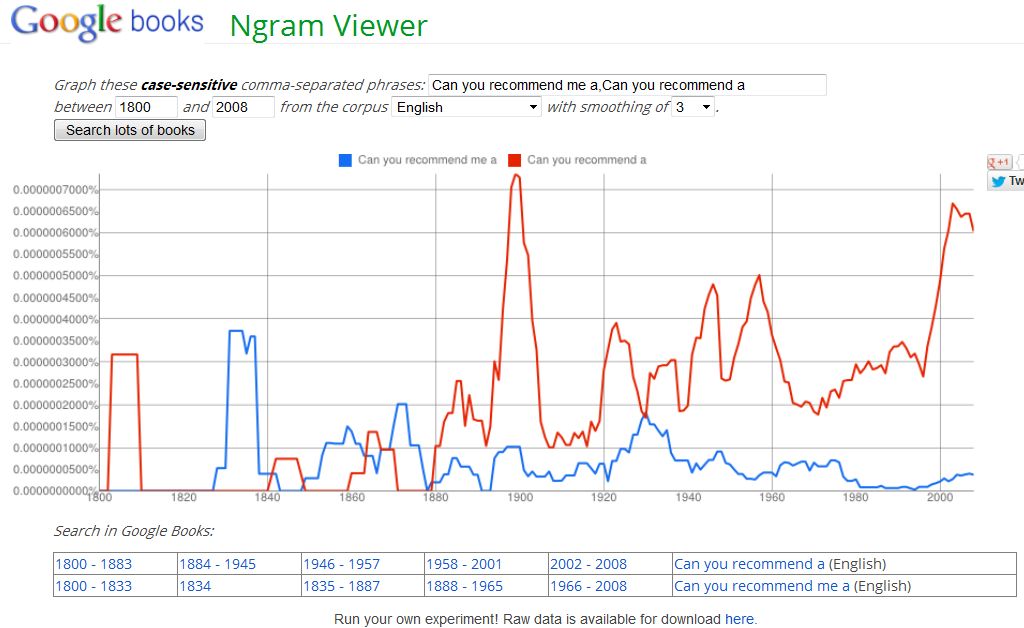
裡頭有提到 Google 的 ngrams(分析一個特定字串在英文書籍裡頭往年的使用情形),所以好奇之下我用了一下(Google有改URL位置):
藍色: "Can you recommend me a"
紅色: "Can you recommend a"     
這基本上和我前頭附的討論串裡頭的英語人士講的情況符合。有些說法是「以前」有(所以會出現在字典收納的例句/用法裡頭),但是現在少用了。比如 "switch" 在「以前」(清朝末年/民國初年)的翻譯是「電門」,這在現在版本的Oxford English-Chinese Chinese-English Dictionary(*2)仍是有收錄這中文翻譯,且是擺在第一個位置。那麼如果現在的學生在考卷上寫「電門」.... 其實也不要說是英文考試,就算是國語/國文科的考試/作業這樣子寫也是會被直接劃掉打錯。

(*1) http://dunchee.blogspot.com/2011/02/blog-post_20.html

(*2) 我是在幾年前有次好奇在一間(美國)書局翻的。黃皮字典,沒記錯的話是Oxford出的。有空我再到書局翻最新版的
----
Update: 我到圖書館和書局找了 English-Chinese (/Chinese-English) 字典來翻,看樣子內容有更新(也多了些以前我沒看過的版本。連瑪爾寇涼的也有),所以沒看到我幾年前翻到的「電門」。不過網路上仍可以找到這個「電門」的蹤跡。除了用 Google Web 可以找到有把 switch 翻成「電門」的網站之外(有興趣的自己玩,我就不另外附上 links),Google Books上也有:


https://www.usingenglish.com/forum/threads/he-recommended-me-a-good-lawyer-a-good-lawyer-to-me.223239/


有空我再擴充/整理/補足

光文法對還不夠

有的時候光是文法對還不夠。如果句子裡頭的一些用詞讓人看不懂,那麼這句子就算如何的「文法正確」也無用:
a sentence
我覺得這個不錯:
    (Written by Robert L.)
      In English, words are placed in relation to one another by word order
    and the use of traffic-directing words such as prepositions. However
    sound the relationship may be grammatically, it accomplishes nothing
    if it is semantically defective, i.e., doesn't make sense. Here are a
    couple of perfectly grammatical sentences:

    - Colorless green ideas sleep furiously.

    - Keltered fleems borkle varmering slorts.

    The first uses recognizable words but conveys no meaning. The second
    is pure nonsense. But both are grammatical.

subject of a gerund phrase

"The handbook of good English" by Edward. D. Johnson

page 26: "1-7 Put the subject of a gerund in the possessive case, if possible"

2 types of gerund:
1. exactly like a noun (not taking direct object)
"... subject(possessive noun) V-ing ..."
2. mostly like a noun but has some characteristics of a verb or a participle
"... subject(objective form / non-possessive noun) V-ing ...." is common
(3. can't be assigned to either type)

page 28: "When the possessive is impossible or bizarre"

"When the subject of gerund is not a simple noun or pronoun but a group of words ..."


(NOTE: 這是給我自己看的筆記,所以我只大概引個內容。想看詳細的內容的人可以用 Google Books  http://books.google.com  找這本書)